
Heard On Sunday -The Four Horsemen: Understanding God's Sovereignty in a Broken World
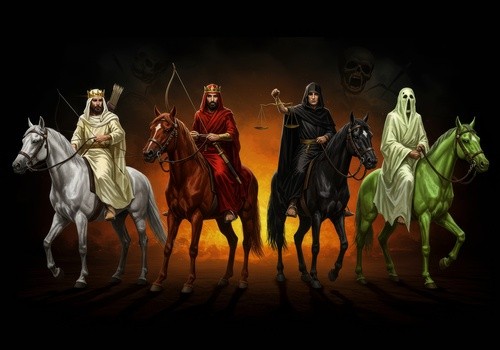
The Four Horsemen: Understanding God's Sovereignty in a Broken World
The book of Revelation often feels like stepping into the deep end of Scripture. Its vivid imagery and apocalyptic language can overwhelm us, so many either avoid it or reduce it to a future timeline we hope to escape.
But what if we’ve been looking at it too narrowly?
A Different Perspective on Revelation
Imagine a football game filmed from several cameras: one on the 50‑yard line, one high in the end zone, and one in a blimp overhead. Same game, same plays, same players—but different angles. Each perspective shows you something unique, even though the outcome never changes.
That’s how Revelation works.
Rather than a straight, chronological checklist of end-time events, John gives multiple “camera angles” on the same reality: God’s work in history from creation (Genesis 1–3), through Christ’s first coming (John 1:14; Galatians 4:4–5), to His return (Revelation 19:11–16; Revelation 21–22). The theological term for this is recapitulation—repeating and re‑viewing the same age from different perspectives.
The Throne Room and the Scrolls
Before the four horsemen appear, Revelation 4–5 gives us the control room of history.
God the Father is worshiped as Creator (Revelation 4:8–11).
Jesus, the Lamb who was slain, is the only One worthy to open the scroll sealed with seven seals (Revelation 5:1–7).
Four living creatures cry, “Holy, holy, holy” day and night (Revelation 4:8).
This isn’t just future; it’s a declaration of who reigns now (Hebrews 1:3; Ephesians 1:20–22). When Jesus opens the seals, He is exercising His authority over events that have characterized the entire age between His first and second coming.
The First Horseman: Deception’s White Horse
This rider has a bow but no arrows. He wears a crown and rides out conquering. Some have thought this is Jesus, but compared to Christ in Revelation 19:11–16, this rider looks more like a counterfeit—a picture of the spirit of antichrist, a deceiving power that has operated throughout history (1 John 2:18–19; 1 John 4:1–3).
Jesus warned:
The antichrist doesn’t show up as obviously evil. Deception usually looks good, sounds spiritual, and twists truth just enough to lead people away from Christ (2 Corinthians 11:13–15; 2 Timothy 4:3–4).
The Second Horseman: War’s Red Horse
Deception doesn’t remain abstract. It leads to hatred and conflict.
Jesus predicted that:
The 20th century alone testifies to this reality: world wars, genocides under Hitler, Stalin, Mao, Pol Pot—tens of millions slaughtered. War isn’t limited to a final seven-year period; it has marked human history because people reject the Prince of Peace (James 4:1–2).
This red horse is God’s judgment through war—sometimes by direct action, sometimes by letting human evil run its course (Romans 1:24, 26, 28).
The Third Horseman: Famine’s Black Horse
“And I looked, and behold, a black horse! And its rider had a pair of scales in his hand. And I heard… ‘A quart of wheat for a denarius, and three quarts of barley for a denarius, and do not harm the oil and wine!’”
(Revelation 6:5–6)
A denarius was about a day’s wage (Matthew 20:2). A quart of wheat would barely feed one person. The picture is of inflation and scarcity: work all day, and you just survive.
Famine often follows war. Scripture frequently pairs sword, famine, pestilence, and wild beasts as judgments (Ezekiel 14:21; Lamentations 5:10).
History echoes this: famines in France, Finland, Ireland; and today, hundreds of millions undernourished while others live in abundance. The black horse reminds us that economic and food insecurity are not random—they’re part of a world under judgment.
The Fourth Horseman: Death’s Pale Horse
“And I looked, and behold, a pale horse! And its rider's name was Death, and Hades followed him. And they were given authority over a fourth of the earth, to kill with sword and with famine and with pestilence and by wild beasts of the earth.”
(Revelation 6:8)
This final rider gathers up the effects of the first three: war, famine, and now pestilence. History has seen:
Again, Revelation is not only about a future week on the calendar. It’s describing patterns that have marked the entire age between Christ’s comings, under His sovereign rule (Daniel 4:35; Psalm 103:19).
Why Would God Allow This?
These scenes are heavy. How can a loving God allow such suffering?
The Bible’s answer holds two truths together:
But Pastor Stu stressed a crucial distinction: God never pours His wrath on His children.
Those who trust in Christ are shielded from wrath because Jesus already bore it in our place:
Jesus Wins—and That Changes Everything
If you remember one line from Revelation, let it be this: Jesus wins.
He is already reigning (Ephesians 1:20–22; 1 Corinthians 15:24–28). The kingdom is both already and not yet (Luke 17:20–21; Hebrews 2:8–9). We still see the four horsemen ride, but we also see the gospel advancing, churches planted, lives transformed.
This should produce two responses:
Living Between the Comings
We live between Christ’s first coming and His return (Hebrews 9:26–28; Titus 2:11–13). In this in‑between time:
The same Jesus who opens the seals (Revelation 6:1) is the Lamb who was slain for our redemption (Revelation 5:6, 9) and the Lion of Judah who conquered (Revelation 5:5).
One day we will join the heavenly chorus:
Until that day, we live as kingdom people in a broken world, bearing witness to the truth that steadies us in every storm:
Jesus wins. And because we belong to Him, so do we.
But what if we’ve been looking at it too narrowly?
A Different Perspective on Revelation
Imagine a football game filmed from several cameras: one on the 50‑yard line, one high in the end zone, and one in a blimp overhead. Same game, same plays, same players—but different angles. Each perspective shows you something unique, even though the outcome never changes.
That’s how Revelation works.
Rather than a straight, chronological checklist of end-time events, John gives multiple “camera angles” on the same reality: God’s work in history from creation (Genesis 1–3), through Christ’s first coming (John 1:14; Galatians 4:4–5), to His return (Revelation 19:11–16; Revelation 21–22). The theological term for this is recapitulation—repeating and re‑viewing the same age from different perspectives.
The Throne Room and the Scrolls
Before the four horsemen appear, Revelation 4–5 gives us the control room of history.
God the Father is worshiped as Creator (Revelation 4:8–11).
Jesus, the Lamb who was slain, is the only One worthy to open the scroll sealed with seven seals (Revelation 5:1–7).
Four living creatures cry, “Holy, holy, holy” day and night (Revelation 4:8).
This isn’t just future; it’s a declaration of who reigns now (Hebrews 1:3; Ephesians 1:20–22). When Jesus opens the seals, He is exercising His authority over events that have characterized the entire age between His first and second coming.
The First Horseman: Deception’s White Horse
“And I looked, and behold, a white horse! And its rider had a bow, and a crown was given to him, and he came out conquering, and to conquer.”
(Revelation 6:2)
This rider has a bow but no arrows. He wears a crown and rides out conquering. Some have thought this is Jesus, but compared to Christ in Revelation 19:11–16, this rider looks more like a counterfeit—a picture of the spirit of antichrist, a deceiving power that has operated throughout history (1 John 2:18–19; 1 John 4:1–3).
Jesus warned:
“See that no one leads you astray. For many will come in my name, saying, ‘I am the Christ,’ and they will lead many astray.”
(Matthew 24:4–5)
The antichrist doesn’t show up as obviously evil. Deception usually looks good, sounds spiritual, and twists truth just enough to lead people away from Christ (2 Corinthians 11:13–15; 2 Timothy 4:3–4).
The Second Horseman: War’s Red Horse
“And out came another horse, bright red. Its rider was permitted to take peace from the earth, so that people should slay one another, and he was given a great sword.”
(Revelation 6:4)
Deception doesn’t remain abstract. It leads to hatred and conflict.
Jesus predicted that:
“Many will fall away and betray one another and hate one another.”
(Matthew 24:10)
The 20th century alone testifies to this reality: world wars, genocides under Hitler, Stalin, Mao, Pol Pot—tens of millions slaughtered. War isn’t limited to a final seven-year period; it has marked human history because people reject the Prince of Peace (James 4:1–2).
This red horse is God’s judgment through war—sometimes by direct action, sometimes by letting human evil run its course (Romans 1:24, 26, 28).
The Third Horseman: Famine’s Black Horse
“And I looked, and behold, a black horse! And its rider had a pair of scales in his hand. And I heard… ‘A quart of wheat for a denarius, and three quarts of barley for a denarius, and do not harm the oil and wine!’”
(Revelation 6:5–6)
A denarius was about a day’s wage (Matthew 20:2). A quart of wheat would barely feed one person. The picture is of inflation and scarcity: work all day, and you just survive.
Famine often follows war. Scripture frequently pairs sword, famine, pestilence, and wild beasts as judgments (Ezekiel 14:21; Lamentations 5:10).
History echoes this: famines in France, Finland, Ireland; and today, hundreds of millions undernourished while others live in abundance. The black horse reminds us that economic and food insecurity are not random—they’re part of a world under judgment.
The Fourth Horseman: Death’s Pale Horse
“And I looked, and behold, a pale horse! And its rider's name was Death, and Hades followed him. And they were given authority over a fourth of the earth, to kill with sword and with famine and with pestilence and by wild beasts of the earth.”
(Revelation 6:8)
This final rider gathers up the effects of the first three: war, famine, and now pestilence. History has seen:
The Black Death (bubonic plague) in the 1300s, killing around 200 million.
The Spanish Flu of 1918, infecting about a third of the world.
AIDS, taking millions of lives since the 1980s.
Recent global pandemics, including COVID‑19.
Again, Revelation is not only about a future week on the calendar. It’s describing patterns that have marked the entire age between Christ’s comings, under His sovereign rule (Daniel 4:35; Psalm 103:19).
Why Would God Allow This?
These scenes are heavy. How can a loving God allow such suffering?
The Bible’s answer holds two truths together:
Humanity is in rebellion.
Since Genesis 3, we have rejected God’s rule and claimed to be our own gods (Genesis 3:5; Romans 1:21–23). Deception, violence, famine, and death are the outworking of that rebellion.
God is holy and sovereign.
Sometimes He judges directly (e.g., the flood in Genesis 6–9; Sodom in Genesis 19; the Egyptian plagues in Exodus 7–12). Other times He judges by stepping back and “giving people up” to the consequences of their own sin (Romans 1:24, 26, 28).
Those who trust in Christ are shielded from wrath because Jesus already bore it in our place:
“For our sake he made him to be sin who knew no sin, so that in him we might become the righteousness of God.”
(2 Corinthians 5:21)
“There is therefore now no condemnation for those who are in Christ Jesus.”
(Romans 8:1)
“Much more shall we be saved by him from the wrath of God.”
(Romans 5:9)
Jesus Wins—and That Changes Everything
If you remember one line from Revelation, let it be this: Jesus wins.
He is already reigning (Ephesians 1:20–22; 1 Corinthians 15:24–28). The kingdom is both already and not yet (Luke 17:20–21; Hebrews 2:8–9). We still see the four horsemen ride, but we also see the gospel advancing, churches planted, lives transformed.
This should produce two responses:
Gratitude
We contributed nothing to our salvation except our sin (Ephesians 2:1–9; Titus 3:3–7). Christ took the wrath; we receive mercy. That should humble us and fill us with praise.
Evangelistic urgency
Billions still live under wrath (John 3:36). Our response is not to sit on our hands and say, “It’s all going to burn anyway.” Instead, we’re called to be salt and light (Matthew 5:13–16), to make disciples of all nations (Matthew 28:18–20), and to plead with people to be reconciled to God (2 Corinthians 5:18–20).
Living Between the Comings
We live between Christ’s first coming and His return (Hebrews 9:26–28; Titus 2:11–13). In this in‑between time:
The judgments of God are real.
The grace of God is available.
The victory of Christ is certain.
The same Jesus who opens the seals (Revelation 6:1) is the Lamb who was slain for our redemption (Revelation 5:6, 9) and the Lion of Judah who conquered (Revelation 5:5).
One day we will join the heavenly chorus:
“Worthy is the Lamb who was slain,
to receive power and wealth and wisdom and might
and honor and glory and blessing!”
(Revelation 5:12)
Until that day, we live as kingdom people in a broken world, bearing witness to the truth that steadies us in every storm:
Jesus wins. And because we belong to Him, so do we.
Posted in Heard on Sunday
Recent
Archive
2026
January
Solomon Thought About Life | Jan 4 | Lesson #3 | 12Let's Memorize the Books of the BibleSunday Focus – God Speaks from HeavenMessage Takeaways - God Speaks from HeavenHeard On Sunday - Unveiling Revelation: A Journey Through ScriptureBecause You Give - Thank you, from Alameda StudentsThe Queen of Sheba Visited Solomon | Jan 11 | Lesson #4 | 12Sunday Focus – A Vision of the Glorified ChristMessage Takeaways - A Vision of the Glorified ChristHeard On Sunday - A Vision of the Glorified ChristWisdom Of God's People | Jan 18 | Lesson #5 | 12Message Takeaways - Sanctity of LifeSunday Focus – Sanctity of LifeHeard On Sunday - Created in His Image: Understanding the Sanctity of LifeFamily Sunday | Jan 25Project Nehemiah - January 22nd UpdateMessage Takeaways - A Church That Doesn’t Love JesusSunday Focus – A Church That Doesn’t Love JesusHeard On Sunday - The Church That Lost Its First Love: A Journey Back to Passionate FaithA Kingdom Divided | Feb 1 | Lesson #1 | 13
February
Sunday Focus – Being Martyrs for JesusMessage Takeaways - Being Martyrs for JesusHeard On Sunday -The Blood of Martyrs: Finding Strength in SufferingIsrael's Evil Kings | Feb 8 | Lesson #2 | 13Sunday Focus – A Church that Compromises the TruthMessage Takeaways - A Church That Compromises the TruthHeard On Sunday -The Deadly Poison of Compromise: A Wake-Up Call for the Modern ChurchElijah Confronted Ahab | Feb 15 | Lesson #3 | 13Sunday Focus – The Jezebel ChurchMessage Takeaways - The Jezebel ChurchHeard On Sunday -The Danger of Tolerating Jezebel: A Call to Truth and HolinessProject Nehemiah - February 19, 2026 UpdateMessage Takeaways - An Autopsy of a Dead ChurchSunday Focus – An Autopsy of a Dead ChurchHeard On Sunday - The Autopsy of a Dead ChurchThe Reign of Ahab | March 1 | Lesson #4 | 13
March
Sunday Focus – A Church that Embraces the Great CommissionMessage Takeaways - A Church that Embraces the Great CommissionHeard On Sunday - The Power of Passion: Lessons from the Church in PhiladelphiaMessage Takeaways - A Church that Nauseates GodElisha the Prophet | March 8 | Lesson #1 | 14Jonah, Prophet to Ninevah | March 15 | Lesson #2 | 14A Vision of Flourishing | The FORGEHeard On Sunday - The Danger of Spiritual LukewarmnessHeard On Sunday - The Holiness of God: Understanding What It Means to Stand in Awe The Holiness of GodOur King is Holy! Empowering Families | The FORGEHosea, Prophet to Isreal | March 22 | Lesson #3 | 14Message Takeaways - Praise to the King of CreationThe Throne Room of Heaven: A Glimpse Beyond the VeilPraise to the King of Creation!Family Sunday | March 29Real Community Insight | The FORGEProject Nehemiah - RHC Transition SchedulePalm SundayMessage Takeaways - The Lamb is InspectedHeard On Sunday - The Perfect Lamb: Understanding Jesus’ Final Days Before the CrossEaster Family Resources
April
Project Nehemiah - Elvis Has Left the Building RHC In the NewsEaster Sunday - Resurrection DayMessage Takeaways - The Truth of the ResurrectionHeard On Sunday -The Unfiltered Power of the Risen ChristA Powerful and Practical Partnership | The FORGEThe Northern Kingdom Was Destroyed | April 12 Message Takeaways - The Lion, the Lamb, and the WorldEaster Sunday - The Lion, the Lamb, and the WorldProject Nehemiah - Thankful for the past and looking toward the future!Heard On Sunday - The Whole World in His HandsFamily Sunday & Open House | April 19Message Takeaways - When God Moves You!First Day at the New RHC - When God Moves YouHeard On Sunday - When God Moves YouFamily Sunday | April 26The Four Horsemen of the ApocalypseMessage Takeaways - Faith Endures in a World Under JudgmentWe need your input - Community Survey | The FORGE Heard On Sunday -The Four Horsemen: Understanding God's Sovereignty in a Broken World
May
Judah's Good Kings | May 3Message Takeaways - The Wrath of the Lamb — Standing Before the Sovereign JudgeThe Wrath of the LambAlpha & Omega Outfitters Sneak Peak | The FORGEProphets to Judah | May 10Heard On Sunday - The Wrath of the Lamb: Understanding the Fullness of JesusMessage Takeaways - The Lamb Shepherds the Nations The Lamb Shepherds the NationsThe Seal of the Living God: Finding Security in an Uncertain WorldGod Promised a New Covenant | May 17Message Takeaways - The Praise of His GloryThe Praise of His GloryStop Chasing Purpose — You Already Have OneCheck Us Out On Social | The FORGEJudah Was Taken Captive | May 24The Antichrist of LegalismThe Antichrist of LegalismThe Antichrist of LegalismOn-Site Counseling Partner | The FORGEFamily Sunday | May 31Prayers Above and Judgment Below